
Digital marketing, online marketing, internet advertising whatever you call it, marketing your company online may be a big deal lately. After all, internet usage has quite doubled over the past decade and this shift has massively affected how people purchase products and interact with businesses.
So, what’s digital marketing? Digital marketing is like all other sorts of marketing its how to attach with and influence your potential customers. the important difference is, you connect with and influence those customers online.
What is Digital Marketing?
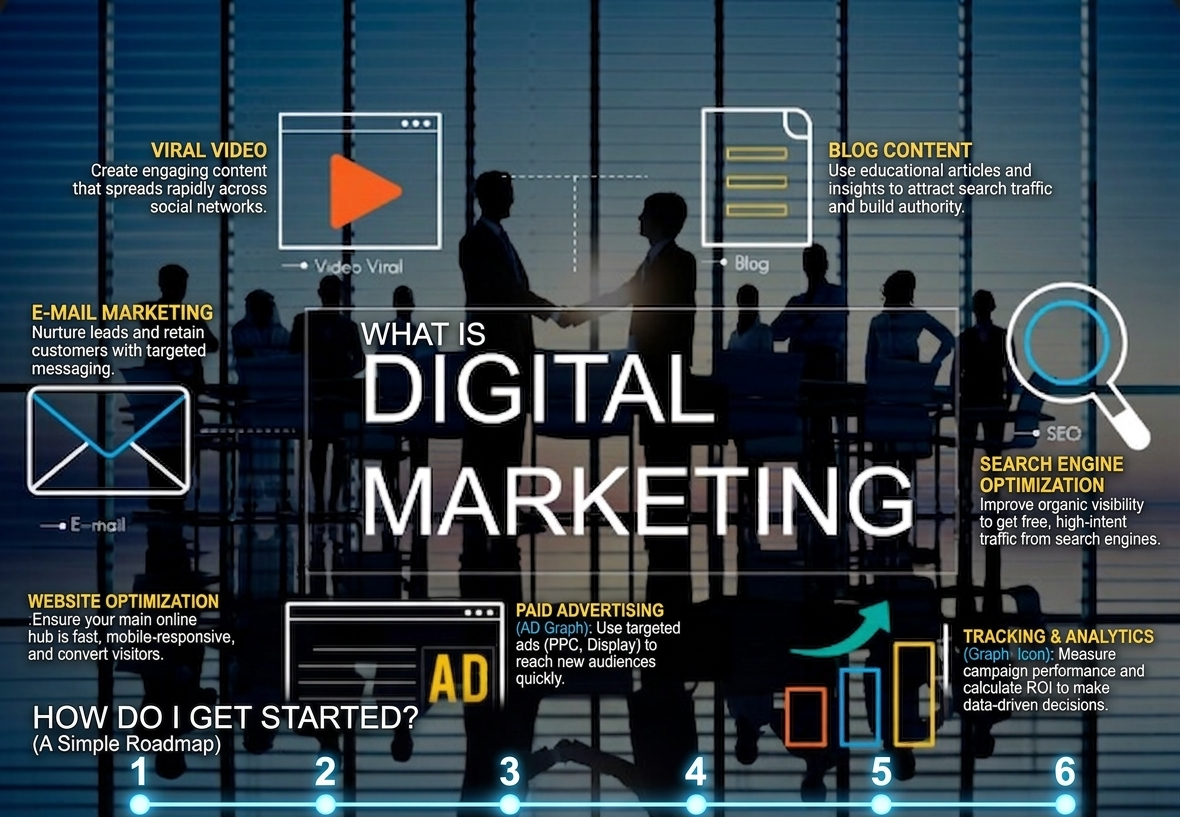
Basically, digital marketing refers to any online marketing efforts or assets. Email marketing, pay-per-click advertising, social media marketing, and even blogging are all great examples of digital marketing they help introduce people to your company and convince them to buy.
Here are some of the most common digital marketing assets and strategies businesses use to reach people online:
Digital Marketing Assets
Almost anything can be a digital marketing asset. It simply needs to be a marketing tool you use online. That being said, many people don’t realize how many digital marketing assets they have at their disposal. Here are just a few examples:
- Your website
- Branded assets (logos, icons, acronyms, etc)
- Video content (video ads, product demos, etc)
- Images (infographics, product shots, company photos, etc)
- Written content (blog posts, eBooks, product descriptions, testimonials, etc)
- Online products or tools (SaaS, calculators, interactive content, etc)
- Reviews
- Social media pages
As you can probably imagine, this list just scratches the surface. Most digital marketing assets will fall into one of these categories, but clever marketers are constantly coming up with new ways to reach customers online, so the list keeps growing!
Digital Marketing Strategies
The list of digital marketing strategies is also constantly evolving, but here are some of the strategies most businesses are using:
Pay-Per-Click Advertising
Pay-per-click (PPC) advertising is actually a broad term that covers any type of digital marketing where you pay for every user who clicks on an ad. For example, Google AdWords is a form of PPC advertising called epaid search advertising (which well go over in a second). Facebook Ads are another form of PPC advertising calledœpaid social media advertising (again, well get into that shortly).
Paid Search Advertising
Google, Bing, and Yahoo all allow you to run text ads on their program Results Pages (SERPs). Paid search advertising is one of the simplest ways to focus on potential customers who are actively checking out a product or service like yours.
Search Engine Optimization (SEO)
If you dont want to pay to show up in the SERPs, you can also use search engine optimization (SEO) to try and rank pages or blog posts on your site organically. You dont have to pay directly for every click, but getting a page to rank usually takes quite a bit of time and effort (for a more in-depth comparison of paid search and SEO,Paid Social Media Advertising
Most social media platforms like Facebook, Instagram, Twitter, LinkedIn, Pinterest, and Snapchat will allow you to run ads on their site. Paid social media advertising is great for building awareness with audiences that might not be aware that your business, product, or service exists.
Social Media Marketing
Like SEO, social media marketing is the free, organic way to use social media platforms like Facebook or Twitter to market your business. And, just like SEO, organically marketing your business on social media takes a lot more time and effort, but in the long run, it can deliver much cheaper results.
Conversion Rate Optimization (CRO)Conversion rate optimization (CRO) is that the art and science of improving your online user experience. Most of the time, businesses use CRO to urge more conversions (leads, chats, calls, sales, etc) out of their existing website traffic.
Content Marketing
Content marketing is another fairly broad digital marketing term. Content marketing covers any digital marketing effort that uses content assets (blog posts, infographics, eBooks, videos, etc) to create brand awareness or drive clicks, leads, or sales.
Native Advertising
Ever get to the rock bottom of a piece of writing and see an inventory of suggested articles? Thats native advertising. Most native advertising falls under content marketing because it uses content to draw in clicks (you all never believe what happens next). Often, native advertising is often a touch hard to identify, since it’s usually mixed in with non-paid content recommendations but thats quite the purpose.
Email MarketingEmail marketing is the oldest form of online marketing and its still going strong. Most digital marketers use email marketing to advertise special deals, highlight content (often as part of content marketing), or promote an event.
Affiliate Marketing
Affiliate marketing is essentially paying someone else (a person or a business) to promote your products and services on their website. As you’ll see from the list above, there are tons of various ways to plug your business online, which is why many businesses either hire workplace to manage their digital marketing efforts or by an in-house marketing team and marketing automation software to hide their marketing needs (for an in-depth comparison of those options, inspect this article).However, that being said, certain sorts of businesses will benefit more from certain sorts of digital advertising. As a fast overview, lets take a glance at which strategies tend to figure best for business-to-consumer (B2C) companies and business-to-business (B2B) companies:
B2C Companies
Generally speaking, B2C companies have much lower cost points than their B2B counterparts. After all, it is often a touch hard to sell a $150,000 drilling bit (believe me, they exist) to a harried mom.
But a $10 pair of kids’ pants? Thats a reasonably straightforward sell.
The good news is because B2C companies aren’t trying to sell incredibly expensive products or services,they dont need big sales teams or complicated marketing funnels.
All they need to try to do is get their products or services ahead of the proper audience with the proper messaging and therefore the rest should look out for themselves.
As a result, the first goal of most B2C companies is to urge people into and thru their marketing funnel. for instance, if you’ll get that harried mom onto your kid’s clothing website and offer her an exciting deal, theres an honest chance that shell buy today. You dont get to build plenty of brand name awareness or trust before you’ll close a purchase.
With that in mind, B2C companies often see great results from higher-funnel marketing channels like social media marketing or paid social advertising. These channels do an excellent job of getting your business ahead of potential customers who won’t otherwise know that you simply exist.
Now, supplementing with other digital marketing strategies like paid search or SEO is usually an honest idea, but if you’ve got to select one channel to start out with, paid social advertising or social media marketing are great options for B2C.
In contrast, paid search is a great option for B2B companies. Most B2B companies have very specific niche audiences that can be hard to target using social media. However, if you sell $150,000 drill bits and someone searches for diamond-tipped oil drilling bit manufacturer, you want to be the first result they see.
Yes, you might pay more for your click than you would with paid social advertising, but with a $150,000 price tag, its money well spent. In addition, most B2B companies have a much longer and more involved sales cycle than B2C companies. If you âre selling a $150,000 drill bit, most people probably dont come to your site, give you a call and say I want one.
As a result, longer-term strategies like content marketing or email marketing are often necessary to close a deal. Of course, the right blend of digital marketing tactics will vary from industry-to-industry and business-to-business, but simply comparing B2C to B2B should help give you a sense of how different strategies can be better for certain businesses.
Not every strategy is right for every business, but with a little trial and error, you should be able to identify the most profitable approach for your company.
The good news is, getting started with digital marketing is fairly easy. Most online advertising platforms make it easy to sign up and create your first campaign (it is how they make money, after all). Here are a few links to beginner guides for several different digital marketing strategies:
Search engine optimization (SEO)
Paid social media advertising
Social media marketing
Conversion rate optimization
Content marketing
Email marketing
1. How Much Do You Need to Make?
- Once you recognize what proportion of money you would like to form from digital marketing, you would like to spot who you’re marketing to. this is
- often critical because different buyer personas require different marketing tactics.
And, even more importantly, different buyer personas become different types of buyers. So guess what? If you dont understand your buyer personas, you cant create an efficient digital marketing strategy! If you ve got a sales team, lecture sales are often one of the fastest ways to urge an honest buyer persona together.
After all, they are those who ask your customers the foremost, right? However, even lecture your sales team and doing touch research isnt enough to actually get at the extent of detail you would like to place together an efficient digital marketing plan. to try to do that, you would like to urge on the phone and call your actual customers. Ask how they found you, why they converted, and what convinced them to pay you.
This information will offer you plenty of insight into your marketing and sales process that you simply can use to both improve the performance of your advertising and choose your marketing budget.
Typically, people look at buyer personas as a good way to craft an effective marketing strategy. Buyer personas are great for this, but they are also an important part of putting together an effective digital marketing plan.
For example, imagine you are advertising for a SaaS business called SaaS-A-Frass that has the following pricing structure:
- Small business Steve
- Mid-market business Mandy
- Enterprise business Edward
Mandy will probably want the Professional package and Edward will likely need the Enterprise package.
Assuming that Steve, Mandy, and Edward stick around for an average of 14 months, 4 years, and 9 years, respectively (average lifetimes for a SaaS client) and buy 5, 20, and 100 licenses (again, respectively), heres the lifetime value for each of these personas ( [licenses/mo] x [# of licenses] x [typical customer lifespan in months] ):
Lifetime Value
Steve: $1,750
Mandy: $72,000
Edward: $1,590,000
A normal SaaS company pays about 22% for fulfillment, 9% to sales and has a 40% overhead, leaving them with about 29% of the lifetime value of each client to play around with. That means to simply break even, SaaS-A-Frass has to spend less than the following to acquire a customer from Facebook:`
How is Digital Marketing Different on Mobile?As you can probably imagine, digital marketing on mobile is very different from digital marketing on desktop. These days, these differences are particularly important because smartphones are now the primary device people use to interact with the internet. With 60% of internet activity taking place on mobile devices, the shift from desktop to mobile has had a profound effect on digital marketing.
Last year, Google Ads got rid of the sidebar ads on their results pages to create a consistent experience between mobile and desktop. Facebook Ads still shows sidebar ads on desktop, but only shows in-stream ads on mobile.
Shorter blog posts outperform longer blog posts on mobile and the list of differences goes on and on. To be honest, in todays digital marketing world, its a good idea to assume that people will encounter your marketing on mobile and then adapt your strategy for desktop as needed. In addition to optimizing your ads for mobile, its also important to think about your site and landing page experience.
Sure, your website might look beautiful on a desktop, but if its impossible to navigate on mobile, youll end up alienating a significant percentage of your web traffic. At a minimum, you should have a mobile-responsive website, but ideally, your mobile experience should be specifically designed to facilitate an effortless mobile experience (not just an adapted version of your desktop experience).
Whether most advertisers realize it or not, digital marketing is primarily a mobile experience now. The good news is, if you’re relatively new to digital marketing, you dont have to worry about reinventing the wheel. You can start by coming up with compelling mobile advertisements and then adapt as needed for desktop.
Conclusion
Incidentally, if this article has convinced you that you need digital marketing (or need to up your digital marketing game), but you like some help identifying the right approach, let us know here or in the comments! We love helping businesses grow with digital marketing.
Did I miss something in this article? Have additional questions about digital marketing? Let me know in the comments!